

IPSC Strategic Intelligence Unit • Recurring assessment
Strategic Risk Matrix
China strategic pressure, assessed on two dimensions: how much an event matters now, and how durably it reshapes the strategic environment.
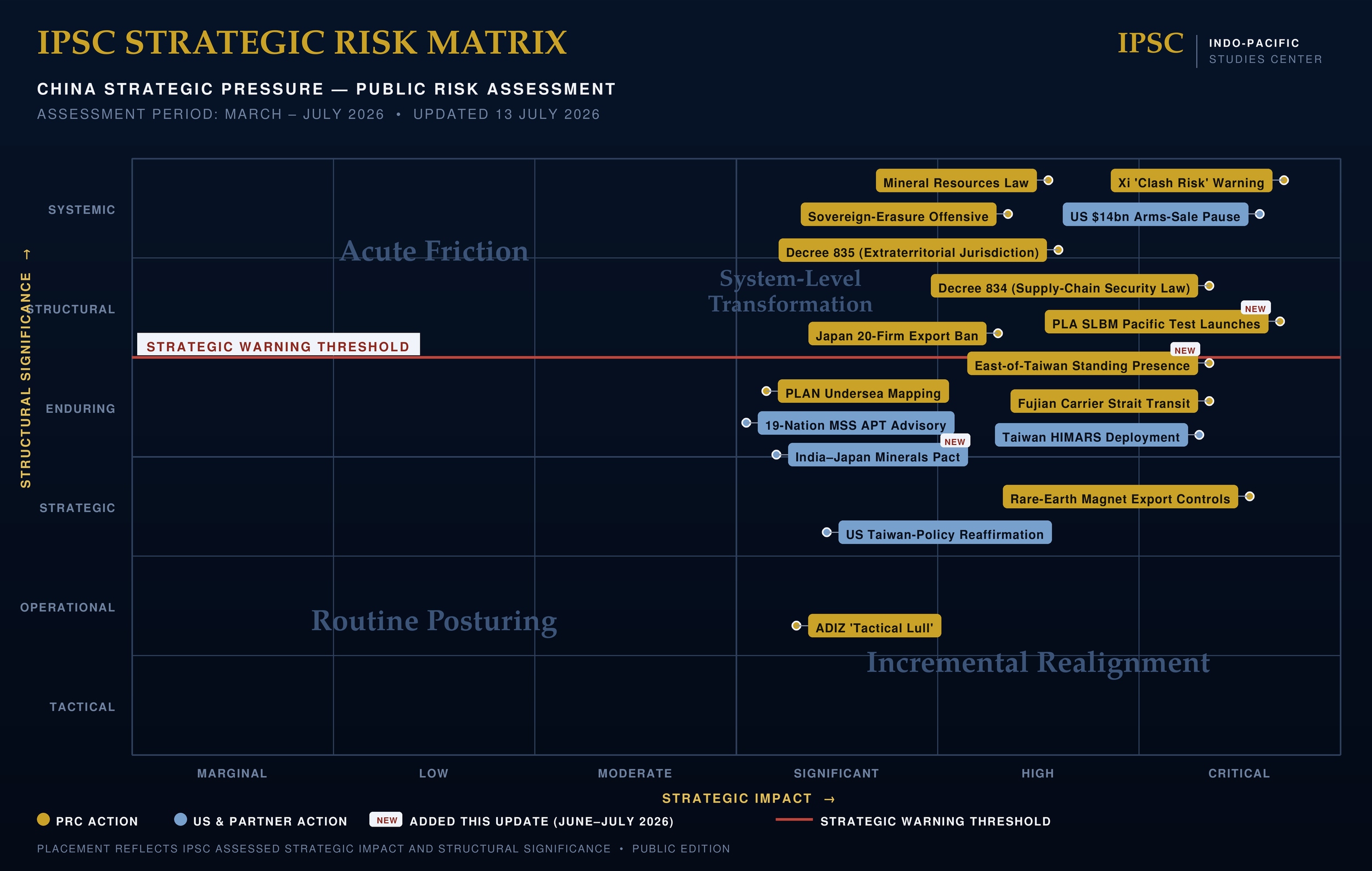
IPSC Strategic Risk Matrix, February – July 2026 (public edition). Placement reflects IPSC assessed strategic impact and structural significance.
June – July 2026 update
What this update shows
First critical-class military event of 2026
A PLA Navy ballistic-missile submarine launched an SLBM from the South China Sea into the Pacific — China's first SLBM launch into international open waters — plotting high above the strategic warning threshold.
Pressure extends east of Taiwan
China Coast Guard and maritime-authority operations in the waters east of Taiwan consolidated into a continuous operating presence, sustained through a 4 July task-group rotation, extending the pressure field beyond the Strait.
Competition written into law
Resource and technology statecraft accelerated on both sides: PRC dual-use controls, supply-chain and counter-jurisdiction regulations, answered by the India–Japan economic-security declaration and allied advisories.
All plotted events
Event register
| Event | Actor | Date (2026) | Assessed placement |
|---|---|---|---|
| Xi 'Clash Risk' Warning | PRC | 14 May | Critical / Systemic |
| US $14bn Arms Package Under Review | United States | 21 May – 3 June | Critical / Systemic |
| Mineral Resources Implementing Regulations | PRC | 20 May / 15 June | High / Systemic |
| Sovereign-Erasure Offensive | PRC | 21 April – 18 May | High / Systemic |
| Decree 835: Extraterritorial-Jurisdiction Regulation | PRC | 13 April | High / Systemic |
| Decree 834: Supply-Chain Security Regulation | PRC | 31 March / 7 April | High / Structural |
| PLA SLBM Pacific Test LaunchNEW | PRC | 6 July | Critical / Structural |
| Dual-Use Controls on Japanese Entities | PRC | 24 Feb / 29 June | High / Structural |
| East-of-Taiwan Standing PresenceNEW | PRC | June – July | High / Structural |
| Heavy-Rare-Earth Export Licensing | PRC | Feb – July | Critical / Strategic |
| Fujian Carrier Strait Transit | PRC | 23 June | High / Enduring |
| Taiwan Distributed Precision Fires | Taiwan / US | May – June | High / Enduring |
| Chinese Dual-Use Seabed Surveying | PRC | March – May | Significant / Enduring |
| Ten-Country China-Nexus Cyber Advisory | Allied coalition | 23 April | Significant / Enduring |
| India–Japan Economic-Security DeclarationNEW | India / Japan | 2 July | Significant / Enduring |
| US Taiwan-Policy Reaffirmation | United States | May – June | Significant / Strategic |
| ADIZ 'Tactical Lull' | PRC | Feb – April | Significant / Operational |
Placements reflect IPSC analytic judgement of strategic impact (horizontal axis) and structural significance (vertical axis). The threshold is not a fixed tier: an event may cross it through exceptional immediate impact or exceptional structural durability. Full sourcing for every plotted event is set out in the public report.
Methodology
Reading the matrix
Each event is placed on two dimensions: strategic impact (horizontal, marginal to critical) and structural significance (vertical, tactical to systemic). The red strategic warning threshold marks the boundary above which events are assessed to alter the structure of the strategic environment itself, rather than operate within it. Event narratives in the report distinguish verified occurrence from IPSC analytic judgement, with sources cited for every plotted event.
Acute Friction
Structurally significant friction of limited immediate impact.
System-Level Transformation
Events both high-impact and structurally durable — the quadrant that defines the current period.
Routine Posturing
Familiar signalling within established patterns.
Incremental Realignment
High-impact events that adjust, without transforming, the strategic balance.
Editions
Archive
- February – July 2026Current Updated 18 Jul 2026
Cite this edition: Indo-Pacific Studies Center, Strategic Risk Matrix: China Strategic Pressure, February – July 2026 (public edition), IPSC Strategic Intelligence Unit, updated 18 July 2026.
© 2026 Indo-Pacific Studies Center • Public edition • Prepared by the IPSC Strategic Intelligence Unit