

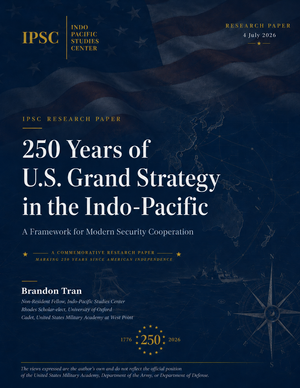
IPSC Research Paper · 4 July 2026
250 Years of U.S. Grand Strategy in the Indo-Pacific
A commemorative IPSC research paper examining the historical evolution of U.S. strategy in the Indo-Pacific and its implications for modern security cooperation.
Executive framing
Why this paper matters now.
The Indo-Pacific is now the central theatre of twenty-first-century strategic competition, economic statecraft and security cooperation. This paper places that reality inside a longer historical arc: 250 years of American strategic engagement with the Pacific and Indo-Pacific worlds.
A 4 July research paper with strategic purpose.
Published for the 250-year anniversary of American independence, the paper asks how the United States’ long Indo-Pacific experience should inform modern security cooperation.
Strategy is not only history. It is architecture.
Brandon Tran argues that the United States should adapt the logic of the hub-and-spokes system to a more complex regional setting: multilateral where interests align, bilateral where strategic friction remains, and indirect where adversarial relationships constrain direct cooperation.
Abstract
The paper’s central argument.
The paper reviews U.S. grand strategy toward the Indo-Pacific across multiple presidential administrations and identifies recurring strategic patterns that remain relevant for contemporary policy.
The Indo-Pacific region is the twenty-first century’s geopolitical and economic centre of gravity, with major strategic importance for the United States and the wider international system. This research paper reviews the history of U.S. grand strategy toward the Indo-Pacific and identifies notable trends across time.
Drawing on those historical insights, the paper argues that the United States should adopt a modernised version of Secretary of State John Foster Dulles’ “hub and spoke” concept to guide regional decision-making. Close partners with extensive histories of cooperation and overlapping interests should be drawn more tightly into multilateral institutions; states with diverging interests or developing relationships should be engaged through bilateral arrangements; and states opposed to the United States may be reached indirectly through U.S. allies and partners.
Key arguments
What readers should take from the paper.
The paper is not simply a historical survey. It uses history to identify a practical framework for modern Indo-Pacific security cooperation.
-
01
The Indo-Pacific has long been central to U.S. interests. U.S. engagement with Asia and the Pacific began through commerce, maritime access and the search for influence beyond the Atlantic world.
-
02
U.S. strategy has repeatedly balanced ideals and power. Republican values, commercial access, maritime power, alliances and hard strategic necessity have repeatedly shaped American policy choices.
-
03
The hub-and-spokes system remains useful but incomplete. Its bilateral flexibility remains valuable, but modern regional conditions require selective multilateralisation and more adaptive coalition design.
-
04
Different partners require different mechanisms. The United States should not impose one cooperation model across a region with diverse threat perceptions, histories and domestic constraints.
-
05
Modern strategy must be flexible and layered. The paper proposes multilateral, bilateral and indirect pathways for cooperation depending on partner alignment and strategic feasibility.
-
06
Security cooperation must address varied risks. The Indo-Pacific’s security challenges include traditional military threats, economic coercion, maritime risk and non-traditional security pressures.
Historical arc
250 years of strategic evolution.
The paper tracks the evolution of U.S. strategic thinking from commercial access and maritime projection to alliance architecture, containment, engagement and balancing.
The Young Republic
Early U.S. strategy focused on Pacific commerce, access to Asian markets, maritime reach and the creation of stepping stones across the Pacific.
The World Wars
The United States confronted the limits of treaty systems, isolationism and unenforced institutions as Imperial Japan rose and the Pacific became a decisive theatre of war.
Containment
U.S. strategy moved through containment, the San Francisco System, hub-and-spokes alliances, nuclear deterrence and flexible response.
Engagement and Balancing
Post-Cold War policy combined economic engagement, alliance preservation, strategic reassurance and balancing amid China’s rise.
Adaptive Cooperation
The paper argues for a flexible architecture that adapts the hub-and-spokes concept to current strategic realities.
Proposed framework
A differentiated model for Indo-Pacific cooperation.
The paper’s strategic value lies in its practical typology: the United States should use different cooperation instruments for different strategic relationships.
Pathway 01
Multilateral integration
States with extensive cooperation histories and overlapping interests should be drawn more tightly into multilateral institutions and regional security arrangements.
Pathway 02
Bilateral engagement
States whose interests diverge from other U.S. allies or whose relationships with Washington are still developing should be engaged through customised bilateral agreements.
Pathway 03
Indirect outreach
States opposed to the United States may be engaged through U.S. allies and partners, creating the conditions for eventual contact, limited cooperation or reduced hostility.
Policy relevance
Why this matters for practitioners.
The paper is relevant for defence, diplomacy, alliance management, maritime strategy and institutional cooperation across the Indo-Pacific.
The paper speaks to live Indo-Pacific policy problems.
-
01
How should the United States work with allies? Through tighter multilateral coordination where interests and threat perceptions align.
-
02
How should Washington manage divergent partners? Through flexible bilateral arrangements that recognise regional diversity and political limits.
-
03
How should adversarial relationships be approached? Through indirect pathways that use allied and partner networks to reduce friction or create future openings.
The paper is designed for strategic-policy readers.
It will be useful for policymakers, defence professionals, diplomats, analysts, students of grand strategy, alliance specialists and Indo-Pacific researchers seeking a historically grounded framework for contemporary U.S. regional strategy.
It also provides IPSC with a strong commemorative asset for outreach to U.S., Australian, Japanese, Indian and wider Indo-Pacific policy audiences.
Download
Read the full IPSC Research Paper.
Download Brandon Tran’s full paper, 250 Years of U.S. Grand Strategy in the Indo-Pacific: A Framework for Modern Security Cooperation.
Tran, Brandon. “250 Years of U.S. Grand Strategy in the Indo-Pacific: A Framework for Modern Security Cooperation.” Indo-Pacific Studies Center, IPSC Research Paper, 4 July 2026.