

Certificate in Indo-Pacific Security
A six-week advanced applied professional program in Indo-Pacific security and strategic analysis. Participants learn to move from evidence to defensible judgement: testing competing explanations, assessing deterrence and escalation, analysing alliances and coercive campaigns, mapping systemic vulnerabilities, and updating assessments as new information arrives.
Events are visible. Defensible strategic judgement is harder.
Military exercises, maritime confrontations, alliance initiatives, economic restrictions and diplomatic signals occur continuously. The advanced analytical task is not simply to describe them. It is to determine what has changed, compared with what baseline, which explanation best fits the evidence, how confident we should be, what could happen next, and what decision the assessment should inform.
What is the baseline?
Distinguish structural change from temporary movement, routine variation from anomaly, and strategically meaningful signals from noise.
Which explanation survives?
Separate observation from inference, surface assumptions, compare competing hypotheses and identify evidence that would change the judgement.
What is likely — and how certain are we?
Distinguish probability from analytical confidence and update assessments as new information changes the evidentiary picture.
What is the strategic effect?
Trace escalation and transmission pathways, identify decision thresholds, and translate strategic developments into concise decision-relevant assessment.
Structured for working professionals — designed for analytical performance
| Duration | 6 consecutive live weeks, preceded by a 60–90 minute self-paced Analytical Foundations Primer |
|---|---|
| Intake | Founding Cohort — begins Thursday, 15 October 2026 |
| Delivery | Live online on Thursdays, with full session recordings, a weekly live session for participants in the Americas and Europe, and asynchronous preparation |
| Lead facilitator | Dr Hugh S. Tuckfield, Executive Director and Founder, Indo-Pacific Studies Center |
| Learning model | Advanced faculty instruction, contemporary evidence packs, structured analytical techniques, live challenge, scenario work and applied decision exercises |
| Analytical method | Baselines, actor–interest–capability–constraint analysis, competing hypotheses, probability and confidence, escalation pathways, indicators, warning, risk transmission and decision relevance |
| Assessment | Six-part Analytical Portfolio culminating in an executive crisis assessment and oral defence |
| Completion standard | 75% overall standard; online lesson checks may be repeated |
| Credential | IPSC Certificate in Indo-Pacific Security |
| Entry requirement | No prior security or strategic-studies qualification required. The pre-course primer establishes the common analytical vocabulary; experienced participants may use it as a refresher. |
Six live modules — one integrated analytical method
Each module combines strategic concepts with current or realistic Indo-Pacific cases, evidence packs, structured analysis and an applied professional output. The program retains the regional-security architecture of IPSC’s flagship course while deepening the analytical method: participants are required to construct judgements, test competing explanations, state uncertainty, identify disconfirming evidence, update assessments and explain the decision implications.
Strategic Order, Power & Analytical Judgement
Examine the distribution of power across the Indo-Pacific and the strategic roles of China, the United States, India, Japan, Australia, ASEAN and Pacific states. Establish baselines, distinguish structural change from temporary political movement, separate observation from inference, surface assumptions, test alternative explanations, and distinguish probability from analytical confidence.
Military Power, Deterrence & Escalation Dynamics
Examine conventional and nuclear deterrence, denial and punishment, extended deterrence, force posture, readiness, mobilisation and strategic signalling. Analyse thresholds, tripwires, vertical and horizontal escalation, inadvertent escalation, commitment problems, off-ramps and the distinction between signalling, preparation and operational intent.
Alliances, Coalitions & Operational Strategic Effect
Examine the US alliance network, AUKUS, the Quad, bilateral and trilateral partnerships, ASEAN-led institutions and emerging security cooperation. Assess commitment, capability, access, logistics, interoperability, burden sharing, domestic political constraints, alliance divergence and adversary perceptions of credibility.
Maritime Coercion, Grey-Zone Campaigns & Strategic Warning
Analyse the Taiwan Strait, South China Sea, East China Sea and critical maritime corridors. Examine coast-guard operations, maritime militia, lawfare, blockade and quarantine concepts, salami slicing, chokepoints and sea lines of communication. Track coercion as a campaign over time: baseline → probe → response → adaptation → normalisation → new baseline.
Geo-economic Statecraft & Systemic Vulnerability
Examine critical minerals, semiconductor competition, export controls, supply chains, cyber infrastructure, artificial intelligence, space systems, telecommunications and submarine cables through a systems lens. Assess concentration, substitutability, switching time, redundancy, stockpiles, sanctions leakage, adaptation and second-order effects.
Crisis Statecraft, Forecasting & Executive Decision Analysis
Integrate the course through a dynamic Indo-Pacific crisis simulation. Participants assess strategic signalling, coercive diplomacy, reassurance, escalation control and policy choice while receiving sequential and sometimes contradictory information. At each stage, update probability, confidence, assumptions, indicators and decision implications.
Build an analytical portfolio — not six essays
Participants complete six different professional analytical products. The emphasis is on concise reasoning, visible assumptions, disciplined uncertainty, updating and decision relevance.
01 · Strategic Change Assessment
Baseline, evidence, alternative explanation, probability, confidence and disconfirming indicators.
02 · Deterrence & Escalation Assessment
Competing hypotheses, thresholds, response branches, indicators and off-ramps.
03 · Alliance Activation Assessment
Political commitment, access, interoperability, constraints, divergence and operational effect.
04 · Coercive Campaign & Warning Dashboard
Campaign progression, cumulative gains, indicators, triggers and threshold manipulation.
05 · Strategic Dependency Stress Test
Dependency, transmission, adaptation, second-order effects and systemic vulnerability.
06 · Executive Crisis Brief
Updated judgement, probability, confidence, decision window, options and oral defence.
Grounded in the security environment as it changes
Teaching draws on IPSC Strategic Intelligence Unit monitoring and research-centre analysis. Participants apply course concepts to contemporary Indo-Pacific strategic problems, rather than relying only on retrospective case studies.
Cross-Strait Security
PLA activity, coercive signalling, blockade and quarantine concepts, deterrence and changing strategic baselines.
Chinese Military Power
Force modernisation, operational activity, readiness, power projection and the strategic effects of growing capability.
Deterrence and Denial
Force posture, credibility, alliance commitments, escalation control and regional deterrence architectures.
Grey-Zone Competition
Maritime coercion, coast-guard activity, cumulative pressure, salami slicing and activity below the threshold of armed conflict.
Chokepoints & Corridors
Maritime routes, ports, logistics, energy flows, submarine cables and strategic geographic leverage.
Economic & Technology Security
Critical minerals, semiconductors, supply chains, export controls, infrastructure and strategic dependencies.
What participants said after the previous IPSC cohort
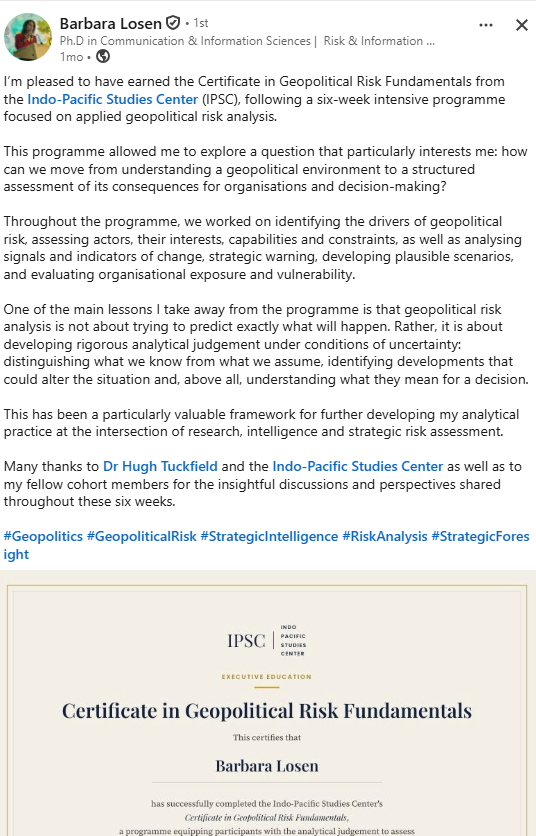
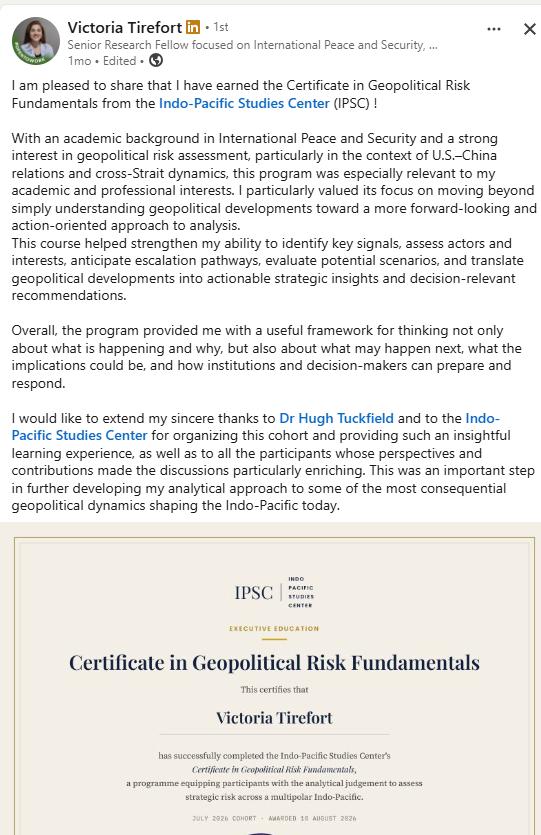
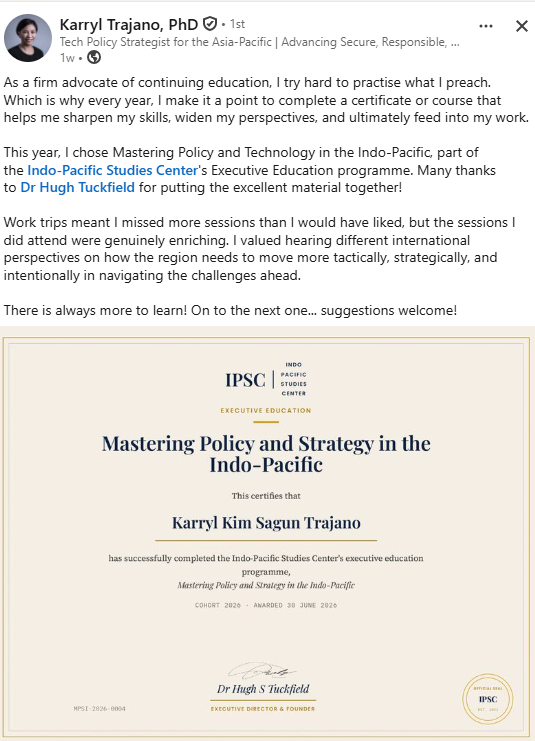
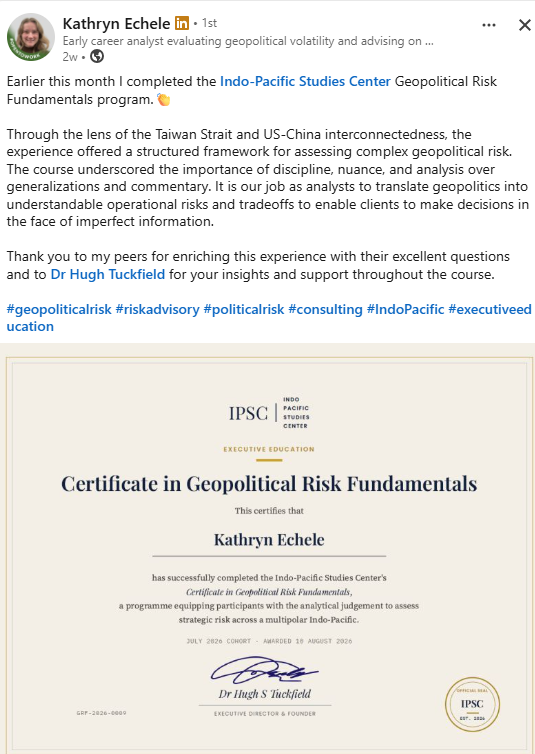
Selected public reflections from participants who completed IPSC’s Certificate in Geopolitical Risk Fundamentals — the curriculum now integrated into this expanded program.
The programme has given me a strong reference for understanding the political and economic forces shaping events, and understanding key actors and context for geopolitical developments.
Throughout the course, we learned to differentiate events from drivers, detect relevant signals and indicators across domains, identify the varying interests, constraints and capabilities of diverse actors, and compress this data into a precise risk brief.
This programme allowed me to explore how we can move from understanding a geopolitical environment to a structured assessment of its consequences for organisations and decision-making.
This course helped strengthen my ability to identify key signals, assess actors and interests, anticipate escalation pathways, evaluate potential scenarios, and translate geopolitical developments into actionable strategic insights and decision-relevant recommendations.
It was a great six weeks. My biggest takeaways have poised me to analyse data with a specific framework and place scrutiny on set parameters to get the best answers for a client or principal.
It has been a pleasure to learn through the Geopolitical Risk Fundamentals course. I look forward to working with IPSC again in the future and learning more.
Professionals who need to understand the Indo-Pacific security environment
No previous security-studies qualification is required; a short pre-course primer establishes the common analytical foundations. The program is designed for participants who need to move beyond following regional developments to producing structured, defensible assessments of strategic behaviour, escalation, coercion, vulnerability and decision implications.
Policy & Diplomacy
Officials, advisers and diplomats interpreting strategic developments and their policy implications.
Defence & National Security
Defence and security professionals seeking wider regional strategic context for their work.
Researchers & Advisers
Analysts, researchers and consultants developing an Indo-Pacific security specialisation.
Business, Media & International Affairs
Professionals whose work requires informed interpretation of regional security and strategic competition.
The IPSC flagship program — founding tuition is offered once
The Certificate in Indo-Pacific Security is the flagship of IPSC professional education, combining regional-security expertise with the analytical tradecraft developed through IPSC’s geopolitical-risk curriculum. Participants learn a repeatable method for moving from evidence to judgement, testing alternatives, assessing uncertainty, identifying warning indicators and translating strategic change into decision-relevant analysis.
US$295
The first cohort of the expanded program, at one-time founding tuition. The same six modules, portfolio and certificate as every later intake — at half the standard fee.
US$595 standard tuition
Standard tuition applies to all later intakes, rising to US$795 closer to each start date. Founding tuition will not be offered again.
Founding Cohort begins Thursday, 15 October 2026
The program runs across six consecutive Thursdays. The main live session is timed for the Indo-Pacific; participants in the Americas and Europe receive full recordings and a weekly live session at a time that suits their region.
| Registration closes | Sunday, 11 October 2026, subject to capacity |
|---|---|
| Session 1 | Thursday, 15 October 2026 |
| Session 2 | Thursday, 22 October 2026 |
| Session 3 | Thursday, 29 October 2026 |
| Session 4 | Thursday, 5 November 2026 |
| Session 5 | Thursday, 12 November 2026 |
| Session 6 | Thursday, 19 November 2026 |
| Main live session | Thursdays, 5:00pm AEDT (Melbourne / Canberra) · 2:00pm Singapore · 3:00pm Tokyo · 11:30am New Delhi |
| Americas & Europe | Full recordings within 24 hours, plus a weekly 30-minute live session on Thursdays at 8:00am AEDT (Wednesday evening in the Americas and Europe) |
Before you enrol
Do I need previous Indo-Pacific or security experience?
No formal security-studies qualification is required. Before the first live session, participants complete a concise Analytical Foundations Primer covering the common method and vocabulary used throughout the program. Professionals who already work with Indo-Pacific security, intelligence, risk or international affairs may use the primer as a refresher.
Is this an academic or practical program?
It is an advanced applied professional program. Strategic concepts are taught through concise faculty instruction and then tested against contemporary Indo-Pacific evidence, competing explanations, structured exercises, scenario injects and decision-focused assessments. Participants are expected to explain not only what they judge, but why, how confident they are, what evidence contradicts the assessment and what would make them change it.
What happened to Geopolitical Risk Fundamentals and Indo-Pacific Geopolitical Risk Analysis?
Their curriculum has been integrated into this expanded Certificate in Indo-Pacific Security, which is now the IPSC flagship program. Escalation frameworks, warning indicators and structured risk assessment from the geopolitical-risk curriculum are applied throughout the modules. Existing registrants have been contacted directly with transfer arrangements.
Will the US$295 founding tuition be offered again?
No. October 2026 is the Founding Cohort of the expanded program, and US$295 is one-time founding tuition. Every later intake is at standard tuition of US$595 or more. Founding Cohort participants receive the identical program, portfolio and certificate.
I am outside Indo-Pacific time zones. How do I take part?
Participants in the Americas and Europe watch the full recording of each main session, then join a weekly 30-minute live session with the lead facilitator on Thursdays at 8:00am AEDT (Wednesday evening in the Americas and Europe). Portfolio products are submitted asynchronously with written feedback, and the capstone crisis simulation and oral defence are scheduled at a time that suits your region. You are always welcome to join a main session live when your schedule allows.
What happens if I cannot attend one live session?
Every main session is recorded and available within 24 hours, together with the slides and evidence packs. Recordings are shared only with enrolled participants. Portfolio products are submitted asynchronously, so a missed session does not prevent certificate completion.
What is required to receive the certificate?
Participants complete the Analytical Foundations Primer, the online lesson checks and the six-part Analytical Portfolio, including the executive crisis assessment and oral defence, and achieve an overall completion standard of 75%.
Can organisations enrol several participants?
Yes. Government agencies, universities, businesses and other institutions may contact IPSC regarding group participation, institutional invoicing or tailored cohort arrangements.
Certificate in Indo-Pacific Security
October 2026 is the Founding Cohort of the expanded program. Founding tuition is US$295 and is offered once — standard tuition from 2027 is US$595. Registration closes 11 October 2026, subject to capacity.
What recent participants said
Selected public reflections from participants in the previous cohort of IPSC’s geopolitical-risk program — the curriculum now integrated into this expanded flagship.
Complete your enrolment details
Complete the short enrolment form immediately below this section. After submission, you will continue to the secure payment page.